
The Chakras – An Overview
Claire Martin Luxton | FEB 16, 2021
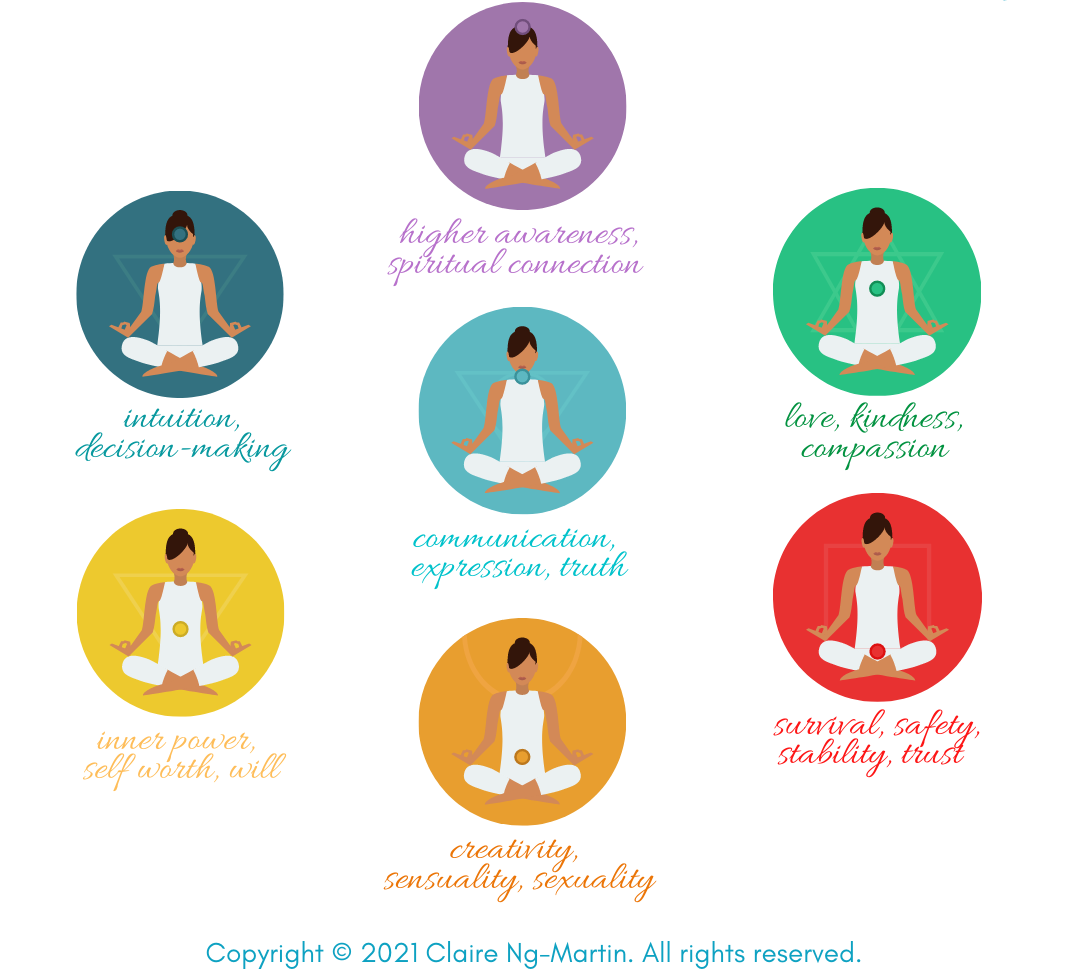
If you are getting to know chakras for the first time, it may seem a bit overwhelming. Don’t worry. You can begin to bring the chakras into your awareness with some basic information and gentle exploration. Developing an awareness of the chakras can help deepen your yoga practice – eventually, you may even notice this awareness seep into your daily life and yield unexpected benefits.
But where to start? Read on for an introduction as to what the chakras are, and where these energy centres exist in the body. From here, you’ll start to understand the importance to your emotional and physical landscape of balancing your energetic body, as well as learning ways to develop a deeper connection to your chakras.
1. What are chakras?
In Yogic Philosophy, the existence of a subtle energetic body is recognised as present within us, alongside our physical body and our mental world.
The chakras are part of the energetic body – they are a group of seven energy centres that run up and down the midline of the body. They are best visualised as colourful spinning wheels (chakra being the Sanskrit word for ‘wheel’), each residing in a separate point along the midline. The chakras are loaded with energy, which stimulates and balances the areas of the body where they are found.
Just like our physical and mental states, our energetic system is susceptible to blockages and imbalances. When our chakras are out of harmony, this can lead to emotional disruptions (anxiety, anger, fear), as well as potential to manifest negatively in our physical body (lethargy, illness, insomnia).
If we can bring our awareness to where our chakras reside in the body and what each one represents, we are enhancing our chances of allowing a stable and free-flowing energy system.
2. Location in the body
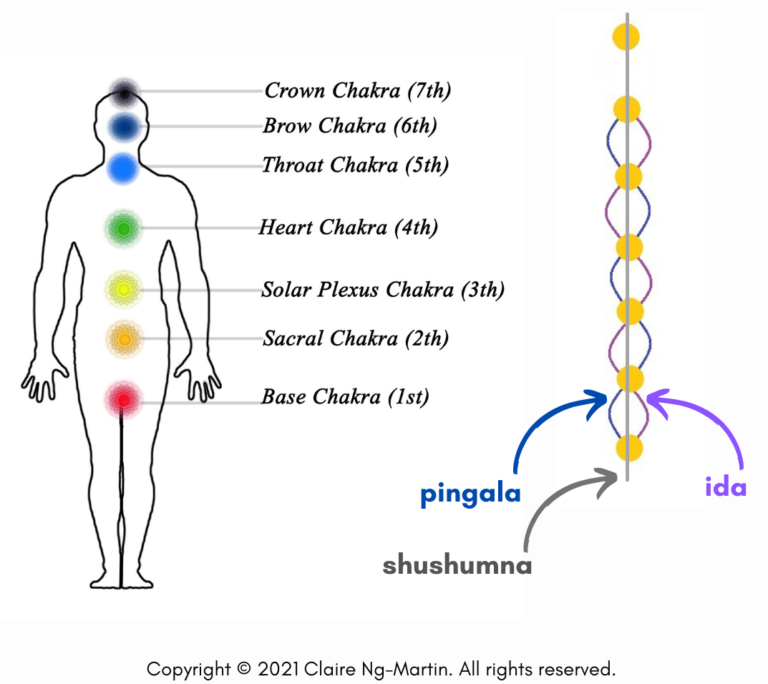
Situated along the midline of our bodies, the chakras run from the base of the spine to the crown of the head. Each of these energy centres sits at an intersection of three main energy channels, known as nadis. The central energy channel is called shushumna, the female channel ida, and the male pingala.
Along our central energy channel, each chakra lies as follows:
- Root – muladhara: base of the spine; pelvic floor
- Sacral – svadisthana: lower abdomen; heart of the pelvic bowl
- Solar plexus – manipura: just above the navel
- Heart – anahata: in line with the physical heart; in the centre of the chest
- Throat – vishuddha: throat area
- Third eye / brow – ajna: between the eyebrows and just above them
- Crown – sahasrara: the crown of the head and just above it
3. Colours
A simple way to further heighten our awareness of our chakras is to visualise them in their own unique colour. It is believed throughout various schools of thought that the colours of the chakras represent the colours of the rainbow.
It is possible to identify whether we are experiencing optimal or stagnant energy flow through the ways in which this manifests in our daily life. If we are experiencing particular emotional or physical distress, it can be helpful to visualise the related chakra changing from a dull, muddy shade, back to a bright glowing colour.
- Root: red is said to be a primal colour – apt for the grounding root chakra
- Sacral: orange is seen as an energising colour – this corresponds to the creativity held within the sacral chakra
- Solar plexus: yellow, as a warm and stimulating colour, connotes our inner fire and self-worth
- Heart: green is a colour associated with health, well-being and vitality
- Throat: turquoise, seen as an intellectual colour – this chakra enhances the energy of true self-expression
- Third eye / brow: indigo or purple represents our intuition and our inner wisdom
- Crown: violet or white stands out as symbolising our spirituality and our interconnectedness
4. Associated emotions
As our energetic body is inextricably linked to our emotional world, we run the risk of emotional consequences stemming from unaligned chakras. Perhaps sometimes we feel that we’re overwhelmed in a particular area, or completely lacking in another.
Through practice, and through having awareness of what each chakra represents, we can more easily tune in and identify those areas that are concerning us, and help the energy to move more freely through the relevant chakra:
Root – safety, stability, survival, trust
- A healthy root chakra can help us to feel stable, safe and grounded.
- We can pinpoint a blocked root chakra if we are allowing anxieties, fears and avoidance behaviours to control us.
- Prioritising self-care in ways that are unique to us can help to redress this balance.
Sacral – sexuality, creativity, fluidity, flow
- When the energy runs freely here, we feel inspired, creative and we are open to sensual pleasure.
- If we experience an issue with boredom and disinterest, this chakra might be out of balance.
- Try to prioritise creative or pleasurable pursuits if you start to feel this way.
Solar plexus – self-worth, inner power, will
- This chakra helps us to feel the power of our self-confidence and individuality.
- Here we might get swept up with ego-based concerns – we can become enveloped in toxic competitiveness or controlling behaviour. Alternatively, we can experience the opposite – a feeling of lack of direction.
- We can practise trusting that we know who we are. We can filter out what doesn’t serve us.
Heart – love, compassion, kindness, gratitude
- A brightly-glowing heart chakra allows us to experience warm and mutually-beneficial relationships.
- If we are experiencing insecurity or loneliness in our relationships, this is a warning sign for our heart chakra.
- Maybe we can allow ourselves to be open to love from others, and we can practise showing others that we appreciate them.
Throat – expression, communication, truth
- When the space within our throat chakra is clear, we can communicate effectively and truthfully.
- The opposite is true when we experience a blockage here – we struggle to speak honestly and openly.
- As difficult as this is for many of us, practising asking directly for what we want can get the energy flowing through this chakra.
Third eye / brow – intuition, decision-making
- This chakra resides at the meeting point of the male (pingala) and female (ida) energy channels – it represents the convergence of our mind and our body.
- When this chakra is balanced, we are able to employ logic and reasoning alongside our intuition.
- Problems with the third eye chakra can lead to feelings of confusion, uncertainty and a lack of self-trust.
- Here, it can be important to keep making small decisions that we know will lead us in the right direction.
Crown – spiritual connection, higher level of consciousness
- Our crown chakra allows us to feel an interconnectedness on a level beyond our physical being; connection to and trust in a higher power.
- When out of balance, we can feel sceptical, apathetic and disconnected.
- Getting outside in nature, or meditating, can serve as reminders of something bigger than ourselves and help to cure blockages here.
5. Associated areas of the physical body, and chakra-focused postures
When our chakras are no longer in harmony, it is not solely emotional fall-out that we notice. Unsurprisingly, given the interconnectedness of our three systems, we can experience consequences within the physical body, as well.
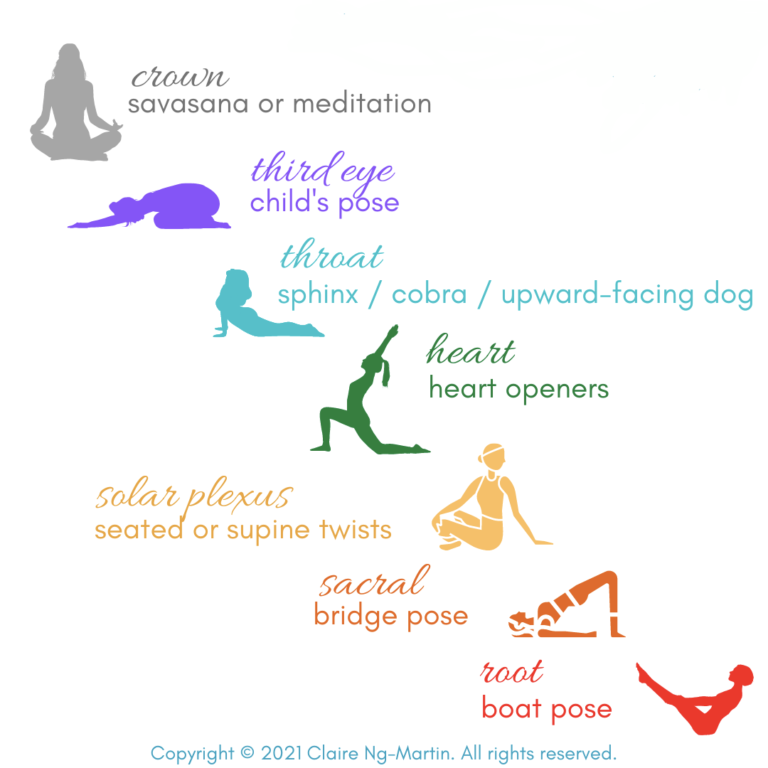
Understanding how to open up the individual chakras using yoga poses can be helpful if we begin to notice signs of disharmony in the body:
Root – instinctive need to feed, sleep, survive / legs, feet
- Physical signs of root chakra imbalance can include pelvic floor issues, or bone and joint pain.
- Hip-opening poses can be helpful for accessing the root chakra, eg: sitting in your cross-legged meditation seat, or coming into malasana (yogi squat)
Sacral – reproductive organs
- This can manifest physically as urinary tract infections, or lower back pain.
- Hip-openers, as well as forward folds, work well for the sacral chakra.
Solar plexus – digestive system
- Here, we might experience food-related issues, such as problems with digestion.
- Incorporate twists in order to stimulate the solar plexus chakra.
Heart – heart, lungs / arms, hands
- Warning signs from the heart chakra might manifest as asthma, poor circulation, blood pressure concerns.
- Heart-opening poses are ideal here, ie: back-bend.
Throat – ears, voice, endocrine glands
- As well as jaw tightness and sore throats, issues with thyroid function can indicate a blockage of the throat chakra.
- Try to open the throat area with poses such as Sphynx pose.
Third eye / brow – sight, sinuses, pituitary gland
- Headaches and eyestrain are a common sign that the third eye chakra needs attention.
- Child’s pose can send energy to the third eye chakra.
Crown – whole body, pineal gland / moving beyond the body to a higher connection
- The crown chakra’s link to the brain and central nervous system can be a possible cause of physical symptoms in the rest of the body. We must also remember that the crown chakra encompasses the health of all other chakras, and so is also connected to all the organs we have already discussed.
- By coming into more contemplative poses such as your meditation seat, lotus pose (padmasana) or supine resting pose (savasana), you can spend time drawing your awareness into your crown chakra.
6. Chakra-awareness exercises
Yoga flow
A chakra-focused yoga flow, including postures such as those outlined in the diagram above, can help to release blockages and get energy flowing freely again.
Visualisation and breath practice
Alternatively, taking a few minutes each day to sit quietly with our chakras can be all it takes to redress the balance that has fallen out of alignment.
Visualise your breath travelling down your spine or central energy channel, and gently touching the centre of each chakra. Visualise their individual colours and see a gentle energy swirling like a wheel.
Chakra awareness with mantras
Mantras can be a good complement to visualisation and breath as a way of actively engaging with each chakra. While visualising our breath travelling to touch each chakra, we remind ourselves of the energy they represent by silently repeating to ourselves:
- Root – I have / I am
- Sacral – I feel
- Solar Plexus – I can / I do
- Heart – I love
- Throat – I speak / I hear
- Third Eye – I see
- Crown – I know

Conclusion
Simple awareness of these colourful wheels of energy is our first step towards deepening our connection with them. Spending time with them on a daily basis will help to keep them clear and free, and will allow them to exist in harmony with us and with one another.
When our chakras work in harmony, this can help us feel more aligned and connected on an emotional and physical level.
Maybe you can identify an area in your life where you feel the associated chakra might be out of sync? Can you sit with awareness of this chakra? Not only will this gentle act of mindfulness deepen awareness of your energetic system, your physical body and your emotional world within your yoga practice but, with time, this heightened awareness may begin to flow over and touch many moments of your life.
Experts differ in their opinions on the subject of chakras, so it’s always good to keep an open mind and be guided by your own experiences.
The topic of the chakras and our energetic system is vast. This article has given you a detailed overview. However, I have provided you with an opportunity to delve deeper below.
Author: Claire Martin
Copy-editor: Kelly Girardi
Resources
Toner, J. 2014, The Perfect Chaturanga. USA
Boorstein Grossman, G. 2015, Restorative Yoga for Life. Adams Media, USA
https://www.chakras.info/chakra-colors/
https://www.healthline.com/health/fitness-exercise/7-chakras#Chakra-101
https://www.yogajournal.com/yoga-101/a-guide-to-the-chakras/
https://www.integrativenutrition.com/blog/2017/02/chakra-basics-get-to-know-your-7-energy-centers
Claire Martin Luxton | FEB 16, 2021
Share this blog post



 OfferingTree